Entering the grove…
A growing archive of pagan, nature-based, and megalithic wisdom. Freely accessible to all who seek.
Browse All ArticlesBrowse by Topic
Nature Philosophy
Humanity's relationship with the living world.
Seasonal Cycles
The eight festivals and the turning wheel.
Nature-Based Thought
History and living practice of the nature-based tradition.
Pagan Studies
Academic and experiential perspectives on pagan paths.
Megalithic Sites
Stone circles, barrows, and ancestral landscapes.
Sacred Geometry
Pattern, proportion, and the language of nature.
Myth & Archetype
Stories that shape consciousness.
Track the turning wheel, sync festivals to your personal calendar, and follow the live rhythms of sun and moon.
Wheel of the YearYour Seasonal Tools
Connect everything to your dashboard
Members get a personal calendar with sync, progress tracking, and seasonal content tailored to their journey.
Begin the PathStructured courses, interactive tutorials, reference materials, and research tools for deeper study.
Learn & Research
The Oak School
Structured courses on archaeology, folklore, and nature practice.
Sacred Geometry Workshop
Interactive compass-and-straightedge tutorials.
The Encyclopaedia
A–Z reference of terms, sites, and concepts.
The Greenwood Library
Curated reading lists and book reviews.
Field Guides
Downloadable guides for visiting sacred sites.
Ancestry of Place
Visual timelines tracing sacred site history.
Research Tools
Data downloads, bibliographies, and citations.
Two interactive maps that connect land and sky. Discover sacred sites on the ground and the astronomical alignments that shaped how they were built.
Choose Your Map
The Land Map
200+ sitesOver 200 ancient sites mapped across Britain, Ireland, and beyond. Filter by type, search by name, and discover sites near you.
Sacred Trails
10 trails10 curated walking routes linking sacred sites into pilgrimages — from gentle Cotswold barrows to epic Hebridean quests. Complete a trail to earn its badge.
The Night Sky
InteractiveAn interactive star chart linking constellations to sacred sites through solstice sunrises, lunar standstills, and stellar alignments. See the sky the ancient builders watched.
Connect with fellow seekers, share photographs and stories, attend events, and track your journey through the sacred landscape.
Visit The HearthJoin In
The Hearth
Discussion forum and community hub.
Events
Gatherings, workshops, and seasonal celebrations.
Passport
Track site visits, complete trails, earn badges.
Gallery
Community photographs of sacred sites.
Contributors
Meet the people behind the project.
The Craft
Hands-on workshops and traditional crafts.
The Nemeton
Members-only live events and mentorship.
The Artisan
Handcrafted goods inspired by ancient traditions.
The Green Man Ezine
Browse All Articles →Nature PhilosophySeasonal CyclesNature-Based ThoughtPagan StudiesMegalithic SitesSacred GeometryMyth & ArchetypeSeasons & Sky
Wheel of the YearMy CalendarSeasonal DashboardKnowledge & Discovery
The Oak SchoolSacred Geometry WorkshopThe EncyclopaediaThe Greenwood LibraryField GuidesAncestry of PlaceResearch ToolsEntering the grove…
Your cart is empty
Explore our collections and find something that speaks to your path.
Extract and prepare woad dye to create the ancient blue pigment used by the Celts, and dye your own cloth.
~180 minutes · Season: litha
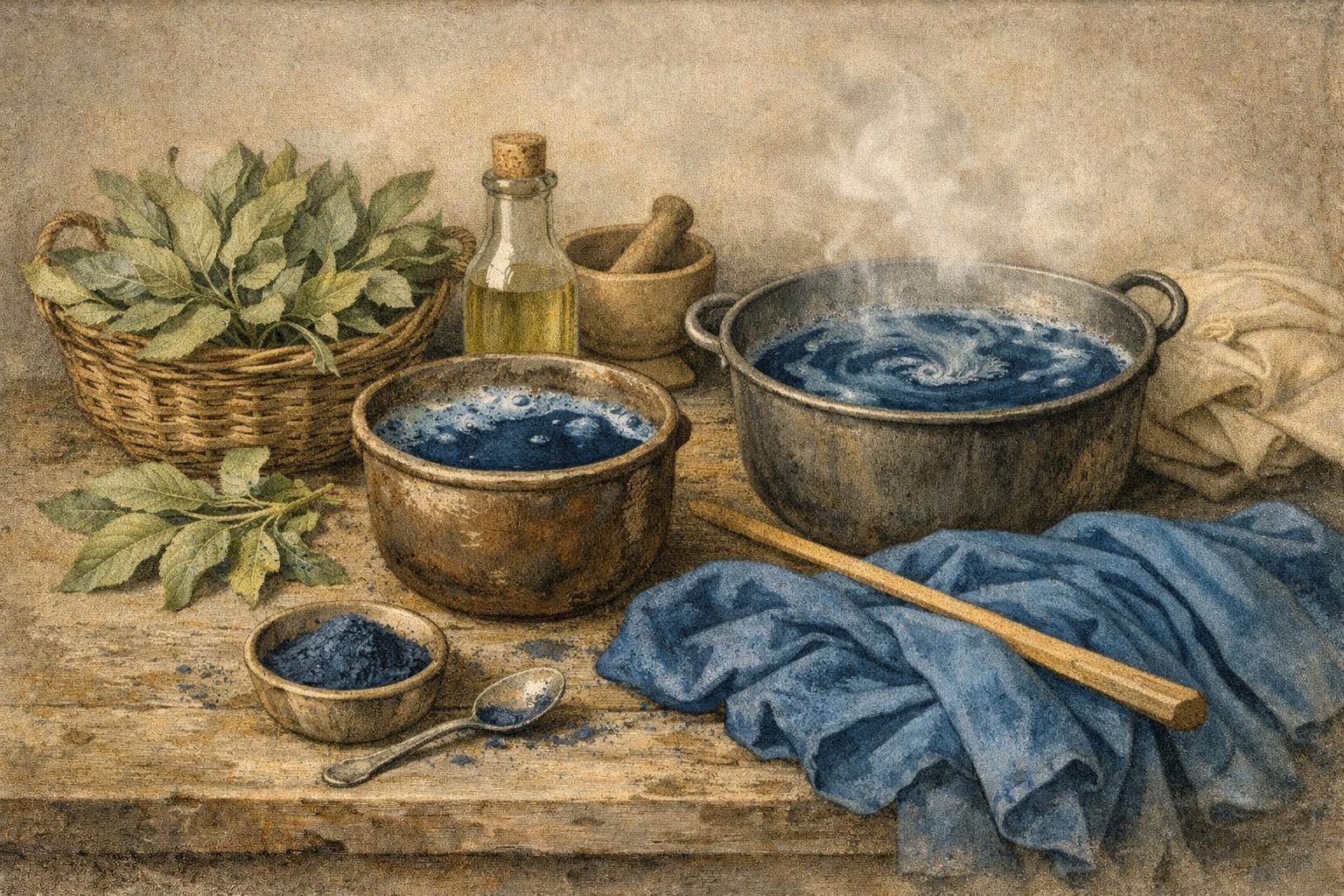
## Natural Dye with Woad
Woad (*Isatis tinctoria*) is the ancient blue — the colour of the Picts, the war-paint of Boudicca's warriors, the sacred pigment of the Celtic world. Long before indigo arrived from the East, woad was the only source of true blue dye in Europe, and its cultivation and use stretches back thousands of years across Britain and northern France.
Growing woad is straightforward — it is a biennial plant in the brassica family, thriving in well-drained soil and full sun. The first-year leaves are harvested in midsummer, when the indigo precursor compound (indican) is at its highest concentration. The extraction process involves crushing the leaves, fermenting the resulting paste, and then carefully managing the chemistry to precipitate the insoluble blue pigment.
In this workshop, you will learn the complete woad dyeing process: from harvesting and preparing the leaf, through the fermentation vat, to the magical moment when cloth pulled from the yellow-green dye bath turns blue on contact with the air. This oxidation — the indigo molecule locking into the fibre as it meets oxygen — is one of the most dramatic transformations in all of natural dyeing.
We will work with cotton and wool samples, exploring how different fibres take the dye differently, and how mordanting (pre-treating the fibre) affects the final shade. You will learn to build and maintain a woad vat, understand the pH chemistry involved, and produce your own pieces of woad-dyed cloth — carrying the ancient blue forward into the modern world.
Safety and environmental considerations are covered throughout. Woad is non-toxic and the spent vat material makes excellent compost, making this one of the most sustainable dyeing processes available.